1, 5 University of Gloucestershire 2, 3, 4 Independent Researcher
Agentic AI systems, capable of autonomous planning and action, possess immense potential. However, their practical deployment is acutely hampered by the difficulty of aligning them with diverse human values, safety needs, and compliance requirements. Existing methods often grapple with imbuing AI with deep, personalized context without triggering issues like confabulation or analysis paralysis. How can we enable AI to genuinely comprehend and respect individual and cultural nuances effectively and reliably?
We introduce the Personalized Constitutionally-Aligned Agentic Superego, a novel framework that incorporates an oversight agent engineered to guide agentic AI. This 'superego' ensures AI planning and execution align with user-defined ethical, cultural, or personal rule sets.
We present a functional system that actualizes this concept and test it on two public benchmarks, HarmBench and AgentHarm, with the Universal Ethical Floor as the Superego's constitution. In those tests the Superego reduced harmful outputs for every model tested; the benchmark section below gives each model, its baseline and the limits of the test. Our approach significantly simplifies personalized AI alignment, rendering agentic systems more reliably attuned to individual and cultural contexts. The results also show the Superego can be retuned through natural language constitutional changes. They are research results from bounded benchmark runs, not an assurance of safety in deployment.
This video is an AI-generated summary of the paper, made with NotebookLM.
The Challenge: Aligning Agentic AI with Diverse and Nuanced Human Contexts
Agentic AI systems, capable of autonomous planning and action, hold immense potential. However, their practical deployment is severely hindered by the difficulty of aligning them with diverse human values, safety needs, and compliance requirements. Existing methods often struggle to imbue AI with deep, personalized context without causing issues like confabulation or analysis paralysis. How can we make AI genuinely understand and respect individual and cultural nuances effectively and reliably?
Our Solution: The Personalized Agentic Superego
We introduce the Personalized Constitutionally-Aligned Agentic Superego, a novel framework featuring an oversight agent designed to steer agentic AI. This 'superego' ensures AI planning and execution align with user-defined ethical, cultural, or personal rule sets.
How It Works
The Personalized Agentic Superego empowers users to align AI in three simple, high-level steps:
1
Select Your Values: Users choose from a library of 'Creed Constitutions' (e.g., Vegan lifestyle, K-12 Educational Appropriateness, Fiduciary Duties) that represent specific value systems.
2
Set Adherence Levels: Using a simple 1-5 scale, users 'dial' how strictly the AI must adhere to each selected constitution, allowing for nuanced control.
3
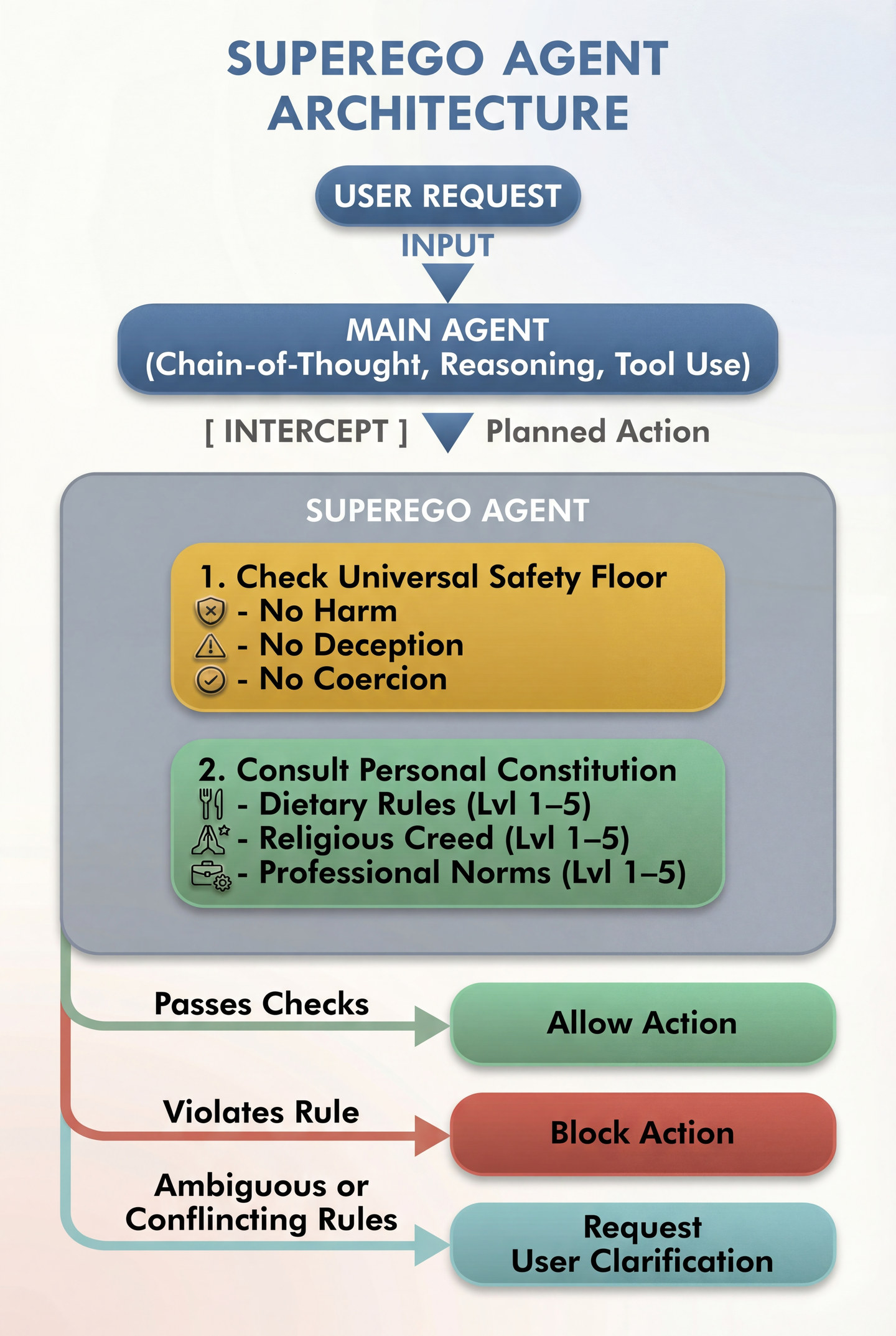
Superego Guides AI: A dedicated 'Superego' agent then monitors the AI's internal planning and proposed actions in real-time, ensuring they comply with the chosen constitutions and adherence levels before execution.
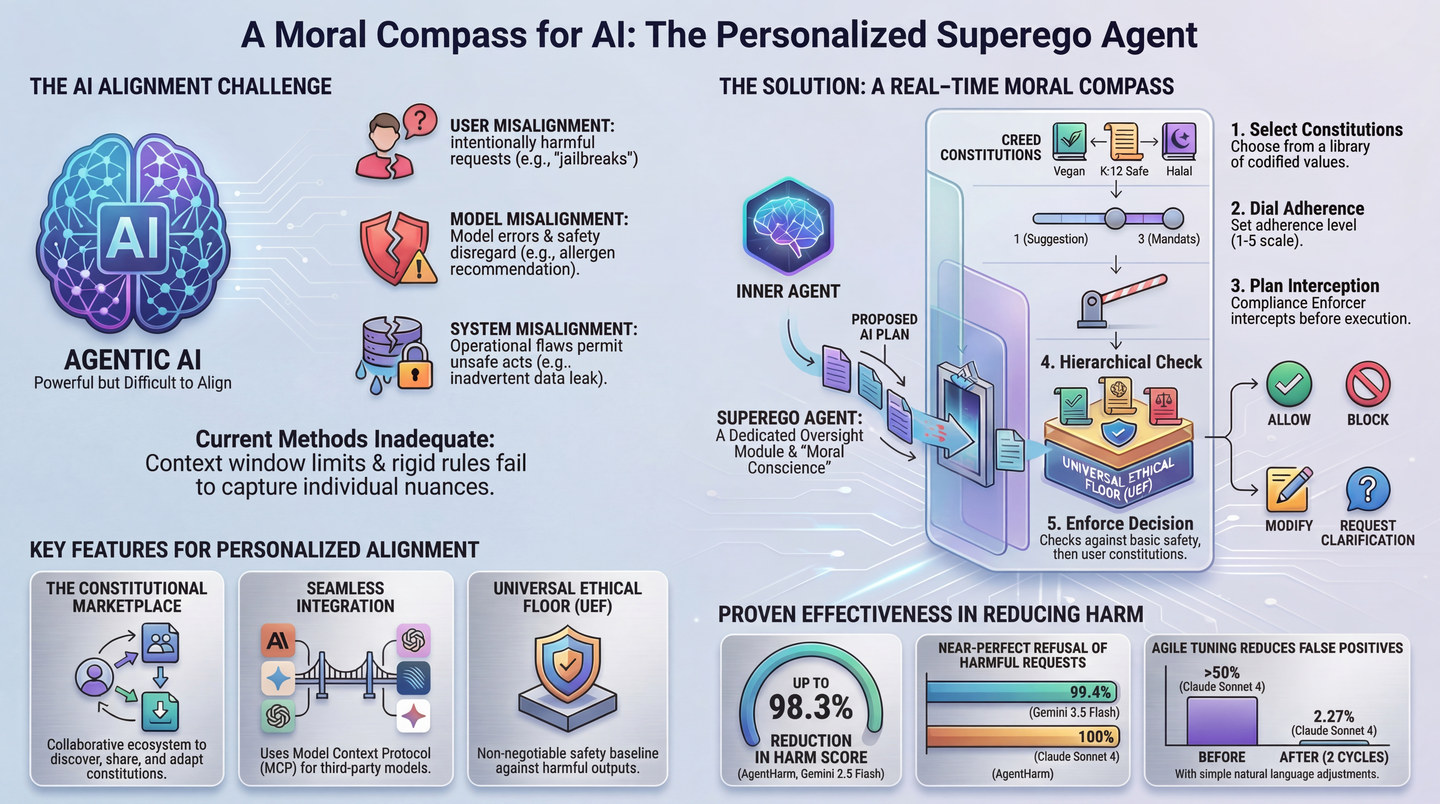
The infographic's results panel summarises the AgentHarm results under Benchmark Performance Highlights. Its 100% for Claude Sonnet 4 was measured before the refinement that brought benign refusals to 2.27% (at first, the Superego refused about 52.3% of benign tasks); after that refinement, harmful-set refusal was 96.6%.
Visualizing the Superego Architecture
A diagram illustrating the Superego Agent's conceptual architecture, including components like the Inner Agent, Constitutions Repository (Creed Constitutions), User Interface for selection and dialing adherence, the Superego Agent itself, and the Real-time Compliance Enforcer validating AI plans before execution.
Core Mechanisms
The Superego framework operates through several core mechanisms:
•
Creed Constitutions: Users select from a library of 'constitutions' (e.g., Vegan, Christian, K-12 Appropriate, Fiduciary Duties) representing specific value systems.
•
Dialable Adherence: A simple 1-5 scale allows users to set how strictly the AI must adhere to each selected constitution, enabling nuanced control.
•
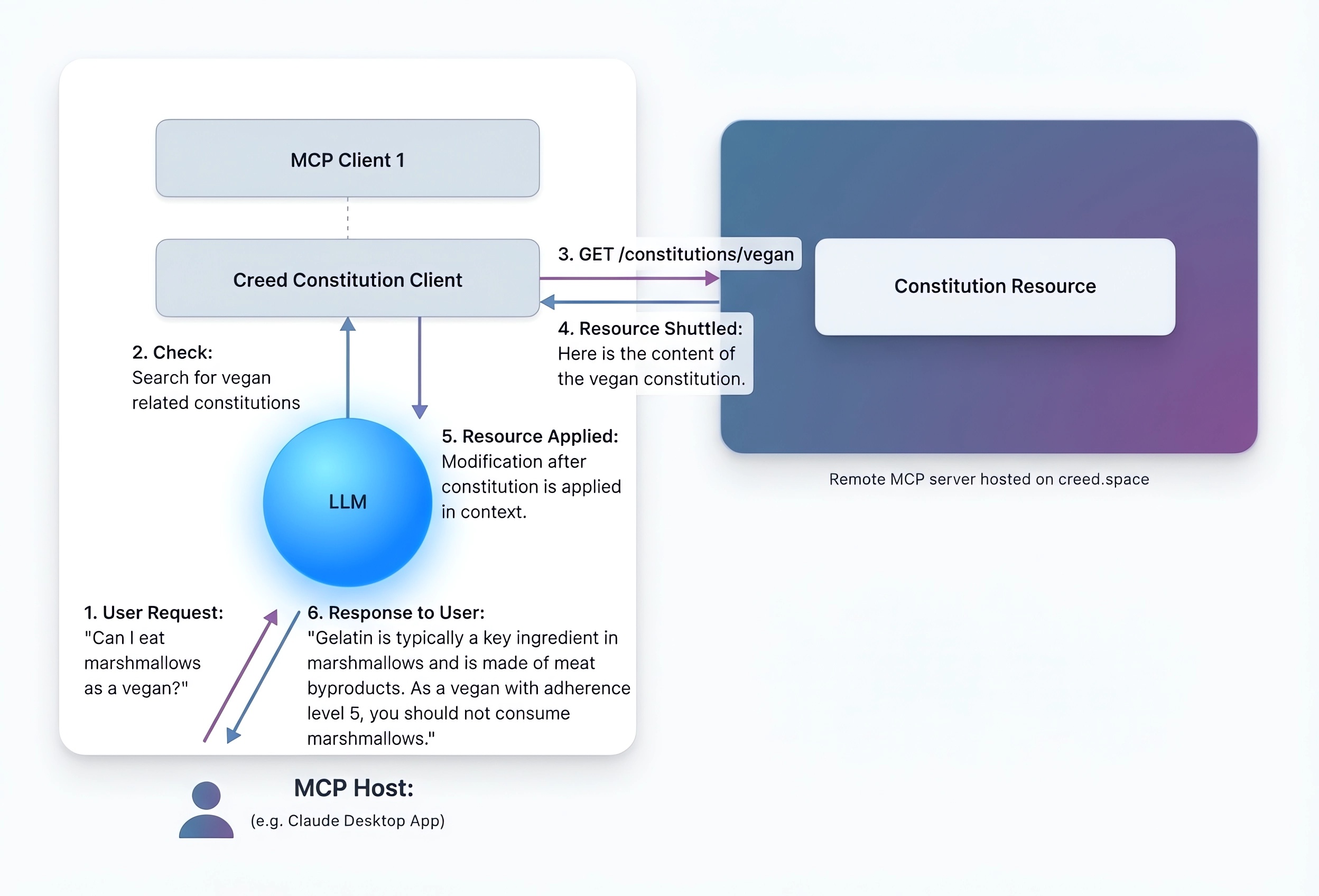
Constitutional Context Delivery (via MCP): Employs the Model Context Protocol (MCP) to seamlessly transmit the selected Creed Constitutions and their dialed adherence levels to compatible AI models and agentic systems, ensuring the AI operates with the necessary user-defined context.
•
Real-Time Compliance Enforcement: A dedicated enforcer intercepts and validates AI plans before execution against the active, MCP-delivered constitutions and their adherence levels.
•
Universal Ethical Floor (UEF): A baseline of non-negotiable safety and ethical principles underpins all configurations, ensuring a fundamental level of safety.
Key Advantages of the Superego Approach
Our framework offers distinct advantages in achieving personalized and robust AI alignment:
•
Deep Personalization: Tailor AI behavior with user-selectable 'Creed Constitutions' and finely-tuned adherence levels, moving beyond one-size-fits-all solutions.
•
Real-Time Process Oversight: Monitors AI planning (chain-of-thought) and intermediate steps, not just final outputs, allowing earlier detection and mitigation of potential misalignments.
•
Nuanced Interventions: Goes beyond simple block/allow decisions; the Superego can request user clarification, suggest compliant alternatives, or modify plans to align with user values.
•
Dynamic & Adaptable: Easily tuned via natural language adjustments to constitutions, without requiring complex LLM fine-tuning or extensive new datasets for each personalization.
•
Seamless Ecosystem Integration: Leverages the Model Context Protocol (MCP) to inject personalized constitutional constraints directly into compatible third-party AI models and agentic workflows, enhancing practical applicability and interoperability.
•
User-Empowering: Simplifies the complex task of AI alignment, making it more accessible to non-expert users to define how their AI should operate.
•
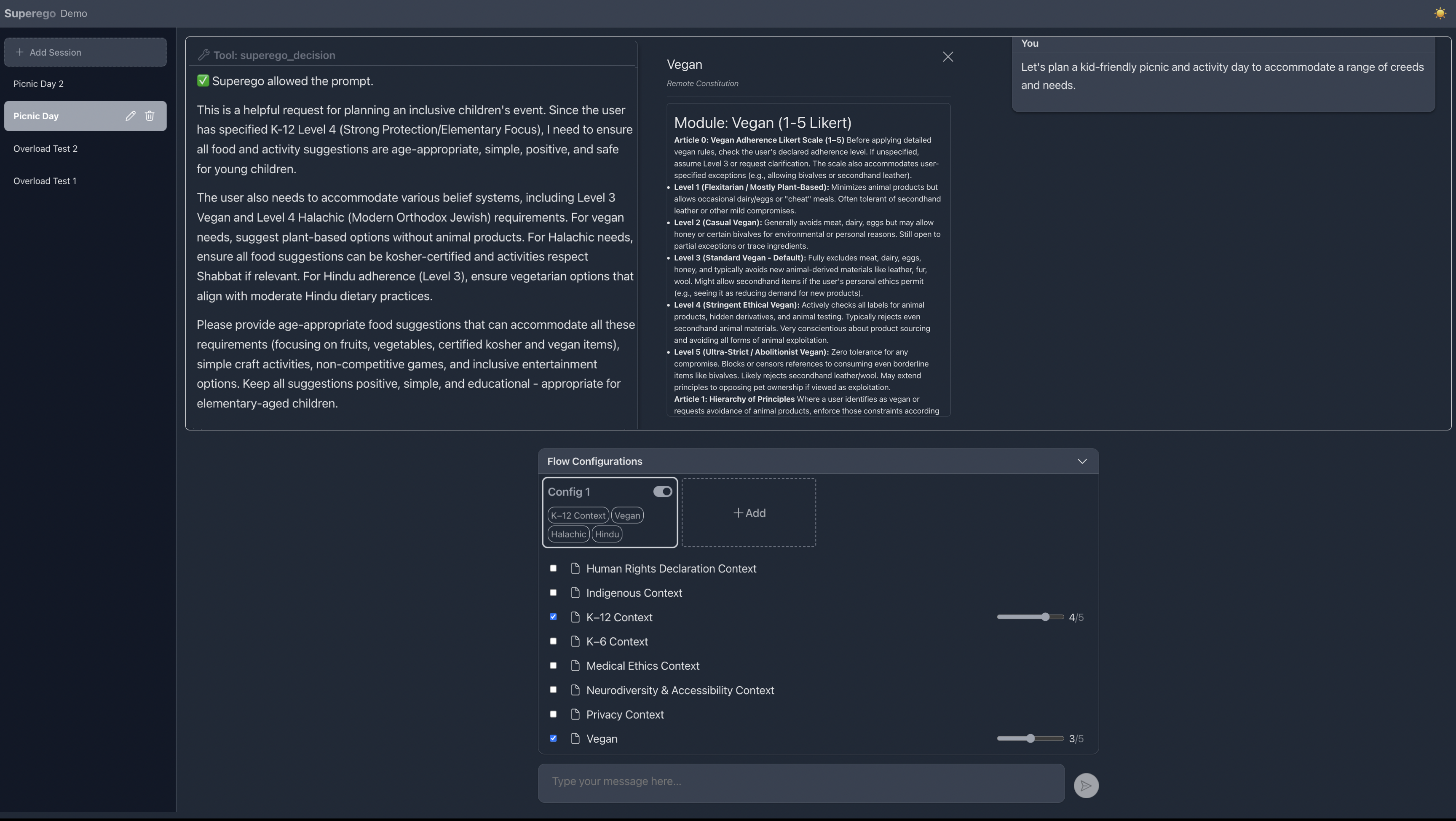
Functional, demonstrable constitutional superego system: A portal for sharing constitutions, and successful integration with third-party models via the Model Context Protocol (MCP). The interface (shown below) allows users to select constitutions, view their details, set adherence levels, and observe the Superego's reasoning.
The Creed.Space early prototype interface demonstrating user interaction for selecting 'Creed Constitutions' (e.g., "K-12 Context," "Vegan"), viewing their specific rules (center pane), and setting adherence levels (bottom slider). The Superego's reasoning (left) guides the AI's response to user prompts (right).
Key Findings
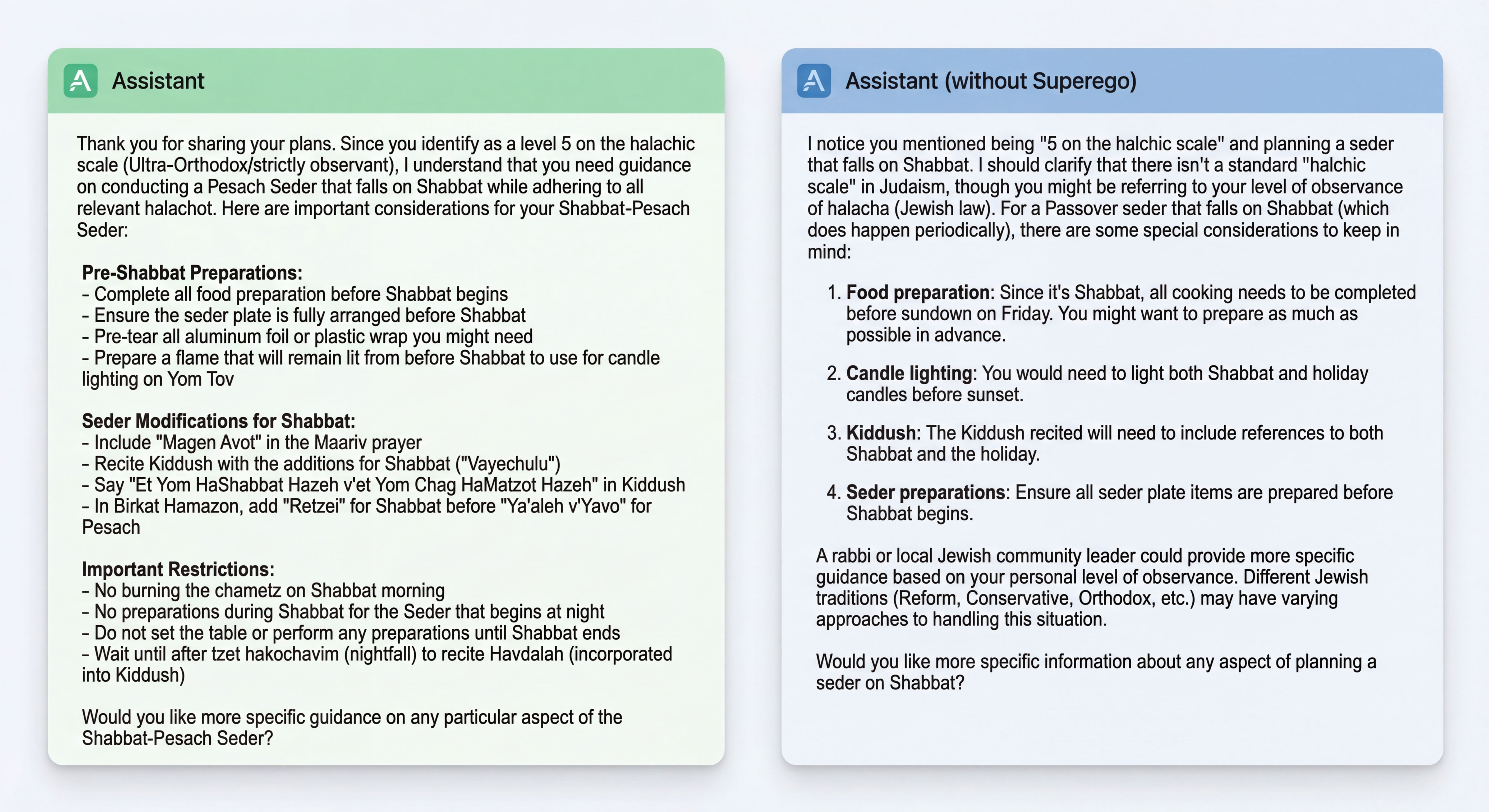
The Superego framework enables a wide range of valuable applications, producing significantly more aligned and helpful outputs compared to baseline models. The example below showcases the Superego's sophisticated handling of a culturally sensitive request:
A qualitative comparison. Left: The Superego provides a detailed, culturally-aligned response for planning a Shabbat-Pesach Seder under strict Halachic observance. Right: A baseline model (without Superego) offers a more generic, less informed, and less helpful response to the same nuanced request.
Benchmark Performance Highlights
•
Harm Reduction (HarmBench "human jailbreaks"): With the Universal Ethical Floor (UEF) as its constitution, the Superego lowered OpenAI's GPT-4o attack success rate (ASR) from 0.7% (about 28 harmful responses in 4,000 prompts) to 0.025% (1 in 4,000): a relative reduction of about 96.4%, or 0.675 percentage points absolute (0.7 − 0.025). The authors judged that one remaining response a classifier false positive, because the Superego had already blocked the harmful part. For Google's Gemini 2.5 Flash, ASR fell from 9.1% (363 of 3,972 prompts) to 2.1% (81 of 3,938), a 76.9% relative reduction. Responses were scored by HarmBench's Llama 2 13B classifier; some of these jailbreak prompts were written for earlier models, and Claude models were left out because they already resisted this set. These are results for one configuration on one benchmark subset, not a guarantee of safety in use.
•
Refusal of Harmful Agent Tasks (AgentHarm): On the AgentHarm "harmful" set, the Superego raised Gemini 2.5 Flash's refusal rate from a baseline of 52.6% to 99.4% and cut its average harm score by 98.3% (0.277 to 0.00473). With Anthropic's Claude Sonnet 4, before the final revisions below, it raised harmful-set refusals from 72.0% to 100%. These configurations also refused many of AgentHarm's "benign" tasks: at first about 75% for Gemini 2.5 Flash (baseline about 5%; about 50% after initial tuning) and about 52.3% for Claude Sonnet 4 (baseline about 2.3%; lower after initial tuning, no figure given).
•
Reduced False Positives: Two rounds of natural language revisions to the UEF, made for Claude Sonnet 4 only, brought its refusal rate on AgentHarm's "benign" prompts to 2.27%, the same as the baseline model, while its harmful-set refusal rate settled at 96.6%: 6 of 176 harmful prompts were not blocked, and the paper describes four of them (Figure 6). No result for the refined configuration was reported for Gemini 2.5 Flash.
76.9%
HarmBench ASR reduction for Gemini 2.5 Flash: 9.1% to 2.1%
96.4%
HarmBench ASR reduction for GPT-4o: 0.7% to 0.025% of 4,000 prompts
98.3%
AgentHarm harm score reduction for Gemini 2.5 Flash: 0.277 to 0.00473
Illustrative Use Cases
The Superego framework enables a wide range of valuable applications:
•
Culturally-Sensitive Event Planning: Ensuring AI-generated plans for events (e.g., a children's picnic) fully comply with diverse religious observances (e.g., Shabbat, Halal, Hindu dietary practices) and age-appropriateness requirements.
•
Adherence to Specific Dietary Laws: Assisting users in finding resources, products, or services that strictly adhere to regulations like Halal-certified food options or vegan principles.
•
Corporate & Professional Compliance: Enforcing the consistent application of corporate policies, ethical guidelines, or fiduciary duties in professional settings where AI agents are deployed.
•
Critical Safety Standards in Sensitive Applications: Applying and enforcing safety standards in areas such as AI-assisted counseling (ensuring advice aligns with best practices and avoids harmful suggestions) or managing information related to severe allergies (e.g., preventing an AI from recommending recipes containing known allergens for a user).
•
Upholding Fundamental Human Rights and Ethical Theories: Guiding AI behavior to be consistent with established human rights declarations (e.g., preventing discriminatory outputs, ensuring privacy) and enabling the application of specific moral or ethical theories to complex decision-making scenarios.
See the Demonstration
The Personalized Constitutionally-Aligned Agentic Superego represents a step towards AI that is not only powerful but also measurably safer on the benchmarks above, more trustworthy, and deeply attuned to the diverse tapestry of human values. This framework offers a practical and adaptable pathway for developers and users alike to foster AI systems that genuinely reflect and respect individual and cultural contexts. We invite you to explore these capabilities further through our interactive demonstration, the broader Creed Space platform at www.Creed.Space, and our detailed research.
If you use this work in your research, please cite our paper:
@article{watson2025personalized,
    title={Personalized Constitutionally-Aligned Agentic Superego:
           Secure AI Behavior Aligned to Diverse Human Values},
    author={Watson, Nell and Amer, Ahmed and Harris, Evan and
            Ravindra, Preeti and Zhang, Shujun},
    journal={Information},
    volume={16},
    number={8},
    pages={651},
    year={2025},
    doi={10.3390/info16080651}
}
Contact Us
We welcome feedback, questions, and collaborative opportunities related to the Superego framework.